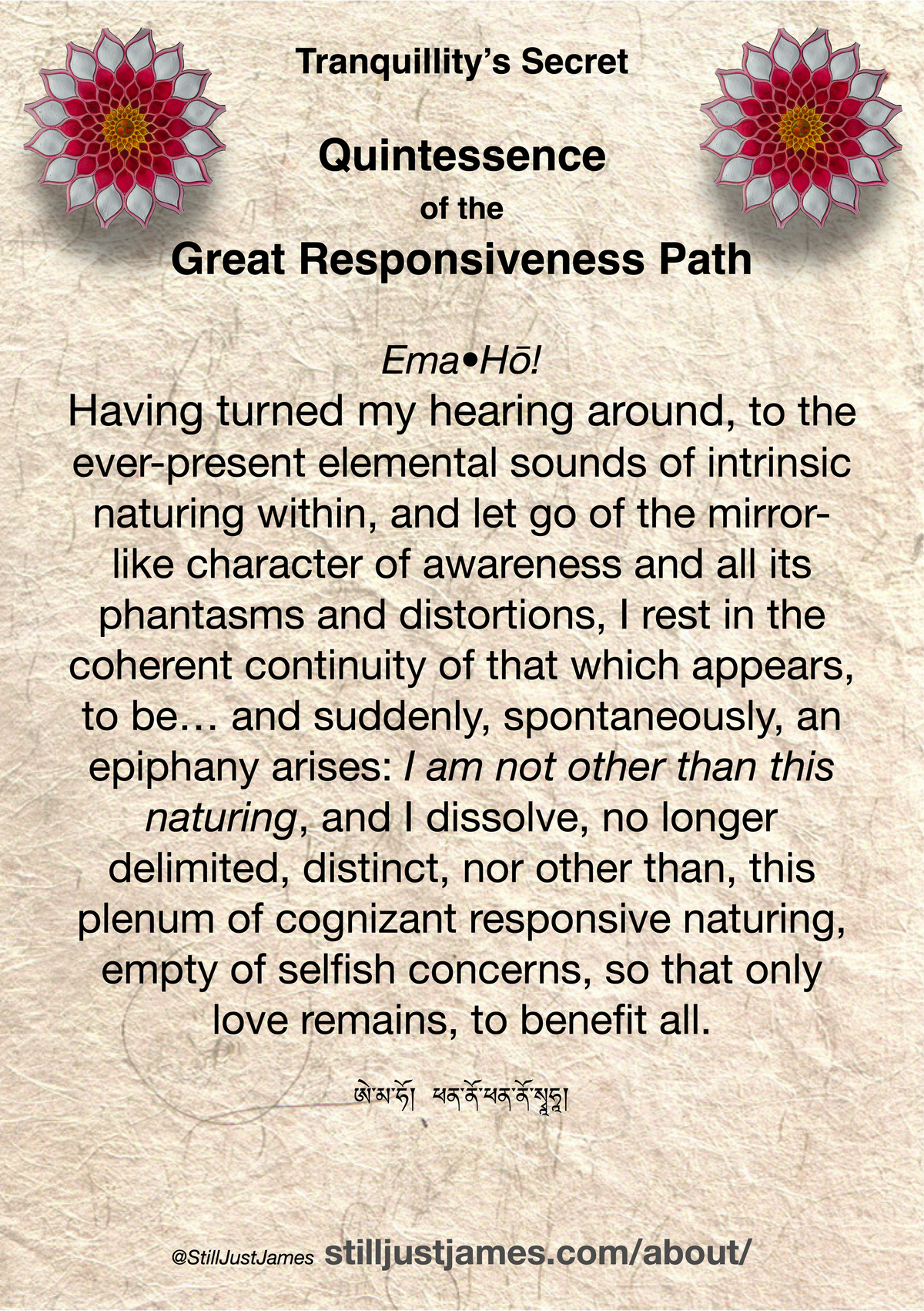
The Great Responsiveness Meditation
There Are Two Paths: The Inner, Using Inner Spontaneous Sound; And The Outer, Using The Intelligibility Of The Appearances.

👈 || UNSAYING | NATURING | TRADITION | MEDITATION | DISCUSSIONS | BACK MATTER || 👉
‘Great Responsiveness’ is an ancient understanding of what came to be known in India, and then in the rest of Asia, and much later the whole world, as Mahākarunā. Today, it is often mistranslated as “great compassion,” but compassion is a feeling that we have for the suffering of others, and even a feeling of wanting to help them — but that is not what 'Great Responsiveness' means. It is the ‘automatic,’ or even better, the immediate, effort that arises from within our very being to help all beings, including oneself, equally. It is our omninclusive response to the suffering of all beings. It is that which our modern culture necessarily suppresses.
Great Responsiveness Meditation is the practice that is described in the Surangama Sutra as being that of Avalokitasvara and Buddha Shakyamuni — in fact, that of all Buddhas. Why? Because Buddhas arise in the absence of any Dharma teachings, and this meditation technique is the only one that can bring you to enlightenment in the absence of teachers and teachings. It is also the practice that is mentioned in the prophecy ‘compiled’ by Jamyang Khyentse Chokyi Lodro in which the Buddha enjoins everyone to do this meditation throughout the period from 2026 to 2032 in order to minimize the trauma of what is happening already and will get worse over this six year period.
There are two paths: the Inner, using Inner Spontaneous Sound; and the Outer, using the intelligibility of the naturing of all appearances. This ‘naturing of all appearances’ is elsewhere referred to as the ‘nature of mind.’
There is one goal: ongoing immediate recognition and contemplation upon the Responsive Naturing of each and every moment of our lives, which is Omnific Perfection, it has the effect of liberating our intrinsic Great Responsiveness which is our true nature, so that we manifest loving concern for all beings, including ourselves, in each and every successive configuration of our lives.
This Omnific Perfection is remarkable in magnitude and effectiveness, and it is ‘perfection’ because it informs all appearances to their actual ontogenetic formal potential in atemporal successions.
This is not the ancient Tibetan practice of Dzogchen in its modern redistillations that say there is nothing that one can do, and nothing that matters, because everything is already perfect, just as it is. While this may seem a tremendous relief from the frenetic pressure of our daily lives in the causal reality we believe we live in, in which we must act to make things happen, it is ultimately a philosophy of hopelessness, moral impoverishment, and a delinquency of our obvious role in what is Natured in our lives.
Earlier understandings of the Great Perfection were not like this, but they also did not have the depth of understanding, nor the subtlety, of the complexity of the appearances that are manifested. Because of this, they did not recognize what the Great Perfection entailed, and left their understanding celebratory and poetic. Whereas they saw the responsiveness as the ‘nature of mind,’ and its ‘simple perfection,’ today we understand that it is a Responsive Naturing — an ongoing, but still spontaneous, ontogenetic and contextual perfection that reconfigures what is manifest in an almost cinematic production that we call perception.
This Responsive Naturing is real and is our total reality, encompassing all that is natured and knowable as ourselves, this world and all possible worlds, as well as and all beings in all these worlds. What was once called ‘Mind’ with a capital “M” to distinguish it from all the lowercase fantastical ‘minds,’ there is truly only the productive principle of Responsive Naturing that natures all in a great perfection that, while being spontaneous, whole, and inseparable, is nonmaterial and unknowable directly. There is neither an entity to which an activity can be ascribed, nor a greater being pulling the strings at every moment. This is why it is called Omnific Perfection.
That which is natured by this autogenous activity becomes actual, without any veridical distinctions of separation, independence, or duration. The illusion that blinds us is that these three distinctions come to be seen as real, so that this Naturing is no longer a whole in our minds. This activity of Naturing is not other than that which is natured. ‘It’ is nondual: neither different in nature from this activity, nor quantifiable as a self, or many selves.
Saying that something is ‘nondual’ asserts that it has a specific kind of essence — that of being indivisible from all there is. So this essence must then not be other than nondual ‘itself,’ which leaves us with the paradox of the essence of this nondual ‘thing’ being not other than the thing. How then, can it be the ‘essence of’ the thing?' We confuse ourselves with language when we create these abstract ideas that have no actuality.
What is natured is intelligible, but is not other than this productive principle of Responsive Naturing. What appears actually to be separate, independent, and lasting, is not other than the whole. These intelligible appearances are not anything other than this principle of naturing. What is 'real' must necessarily be seen as being nonmaterial, and thus, non-actual. ‘It’ is that about which nothing can be truly said. What is 'actual' is simply the nonmaterial activity that we take to be actual.
Take note of this assertion: “that about which nothing can be truly said.” It doesn’t mean that nothing can be said about what is real — what, after all, would unenlightened philosophers, scientists, priests, lesser gurus, demigods, and false preachers have to talk about? Instead, it means that there is nothing that can be said about ‘it’ that is true.
As soon as we try to indicate ‘it,’ or describe ‘it’ in any way, other than simply acknowledging that it is necessary and evidenced, we have left ‘its’ traces far behind. To say that ‘it’ is ineffable is a limiting characterization placed upon ‘it.’ All we can speak of is the felt presence that we can veridically identify with, which is omnintrinsic and omninclusive of all that is. This is why we use the reverberations and appearances of Naturing for this meditation, because they are the information of this Naturing.
‘Information’ is the activity of informing, which means to ‘make actual in a concrete way.’ This is the original meaning of the word “information,” prior to its exploitation as a substitute word for designating the ‘knowing of something without any cognizance of it,’ which has freed those who do not want to become embroiled in the quagmire that has been created by the idea of one or more ‘consciousnesses,’ to just ignore the problem. But this corruption of the word “information” is a phantasm born of the cognitive confusion that something can be known in the complete absence of any cognizance of it.
These reverberations are the inner spontaneous sounds that we can become cognizant of as the Naturing of the appearances informs them via the successive reconfigurations of this productive activity. Meditating on these inner spontaneous sounds can bring one to a state of transverberation.
This reverberation of sound is our most direct and immediate cognizance of the Responsive Naturing upon which this practice is founded. Those that have trouble, or are unable, to ‘turn their hearing around,’ from outer to inner hearing, must rely instead on the presence of the appearances as they are cognized in an immediate recognition of what has been done in each successive reconfiguration that is actual. Elsewhere, this immediate recognition was referred to as an ‘experience of the nature of mind,’ as if it were like a headline on a newspaper.
The benefit of these reverberations are that it is like having someone calling out to you, “Over here! Over here!” while waving their hand to come, so that your attention is focused immediately on this Naturing of these inner spontaneous sounds. While cognizance of the presence of the appearances is like looking for something when you can’t remember where you left it.
What is the benefit of this practice? Besides the first-hand knowledge of our true nature, just resting with this Naturing has a calming effect that fills us with a feeling of tranquillity, like that of ‘being home’ for the very first time, and that makes all the difference in our lives. This is why we call the Great Responsiveness Meditation ‘a practice,’ in the same way that eating your daily meal(s) can be said to be a practice. The food gives you sustenance for your day, and the meditation gives you tranquillity so that you live your day in comfort, even in the absence of a meal.
How then does one start this practice? In the inner practice using spontaneous sound, one simply turns their hearing around to listen to, at first, the high-pitched squeal that is referred to as tinnitus by medical doctors. One then ‘softens’ their focus and concentration on the tinnitus sound, so that with a wider and more open attentiveness, like that one might have when wandering through a wild forest at night, listening for, and immediately turning to, each and every sound, no matter how slight, for any sound might be evidence of a predator about to attack you. Suddenly realizing that there are sounds ‘behind’ the high-pitched squeal, one focuses on the inner spontaneous sounds of the four elements: Earth, Water, Fire, and Wind. Accomplishing that, one simply contemplates the naturing that is not other than you.
Elsewhere, for the outer practice, there is a tradition of an initiatory experience, usually by the teacher startling the student with a forceful and loud shout of “PHAT!” While it is effective, it depends on the student’s ability to contemplate their mind during this event, which necessarily happens without warning. However, I have discovered a different method for inducing the same momentary arrest of our thinking, that can last for multiple minutes — and longer, depending on the student’s ability to let their thinking mind be at rest. This new initiatory experience results in a silent mind, whether for just a couple of minutes, or hours, and days. It is based upon the work that I have been doing for several years on the two phases of perception, in which the second phase, that of thinking about and decorating our immediate experience, does not happen, so that only the first phase, which I call ‘imperience’ occurs. Imperience is an immediate recognition of what is done in each moment of our lives by Responsive Naturing. In this way, what we experience is what is called elsewhere “the nature of mind’. Contemplating the silence of the mind is the initiation to what is called elsewhere in Tibetan Buddhism as “Rigpa.”.
There is a way of seeing the world different.
ཨེ་མ་ཧོ། ཕན་ནོ་ཕན་ནོ་སྭཱཧཱ།
👈 || UNSAYING | NATURING | TRADITION | MEDITATION | DISCUSSIONS | BACK MATTER || 👉