
Our Experience of Fluid Motion in Film and Video Evidences a Novel Understanding of Cognizance
The Ability To Create Motion From Coherent Static Images Has No Survival Benefit Because There Are No Naturally Occurring Streams Of Static Images

👈 || UNSAYING | NATURING | TRADITION | MEDITATION | DISCUSSIONS | BACK MATTER || 👉
My study of the prehistoric paintings in the Lascaux cave in Southwest France, as well as other local caves in the area, has been one of increasing respect for the early human artist-shamans that created these artworks. It has been humbling as well to see how little we have added to their understanding of human perceptual abilities.
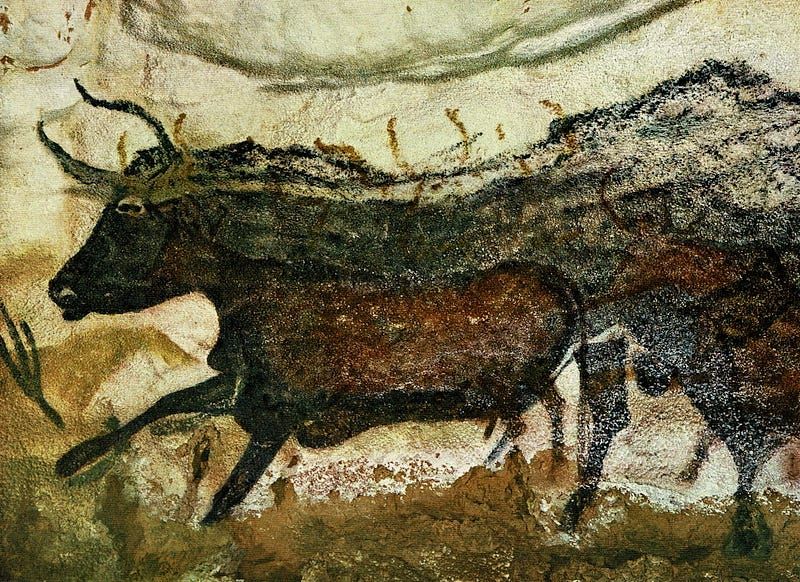
One example of their understanding is a painting technique using superimposed images and partial images. These paintings were at first considered to be the work of successive artists who didn't like the earlier paintings and so covered them over. In fact, they were the equivalent of film-strips. They weren't superimposed images, but were, instead, multiple 'takes' on the same body. So a horse might have three heads, with one fully colored, and the other two 'grayed out' to show intermediate positions of the head. In 1956 Germaine Prudhommeau, a researcher with the CNRS in Paris, realized what the paintings were. She wrote about a frieze of deer heads in the Lascaux cave and she suggested that: "if we apply the cinematographic synthesis process to it, we see the animal give big headbutts forward”.1 Another researcher, Marc Azema, explained in 2011 that:
In France, 53 figures in 12 caves represent movement using superimposition, shown by multiple images in the same place of the legs (31 cases), thus depicting rapid paces (trot or gallop), less often the tossing of the head (22 cases) and more rarely that of the tail (8 cases). Representation takes two forms: either by the addition of a second version, more or less complete, of the part of the body concerned, or by the multiplication of barely sketched contours (lines) around the head or legs, which generates a sort of dynamic flux. Lascaux is the cave with the greatest number of cases of split-action movement by superimposition of successive images. Some 20 animals, principally horses, have the head, legs or tail multiplied.2
Our early modern human ancestors were drawing the motion and body movements of the animals they depicted 21,000 years ago! Their efforts were intentional and meant to be viewed as actual motion of the animal. But how did that work? What would it take to actually experience the motion encoded in these paintings?
Our ancestors did not have our technology. They couldn’t easily decompose these superimposed images, so that they could view them in sequence — in fact, they also did use the technique of the juxtaposition of successive images, as Azéma mentions in the quote above. So these were special images. From our perspective today, and with our intimacy with film and video, one might say that these were unremarkable efforts of a race that was somehow less developed than we are. But were they? Every time I watch the lion movement that is carved on a bone in a video of Azéma’s, I get tears welling, so amazing is the fluidity of the movement, and so lifelike even without fluid motion. And this was key for me.
Hyperphantasia is the ability to visualize something that is as present as a normal perception. These superimposed images created by our early modern human ancestors who lived 21,000 years ago could have been decomposed visually, and the coherent continuity between the images could then be recognized in the form of an actual perception of motion. This means the images did not have to be decomposed manually first. Someone with hyperphantasia could experience the motion immediately. David Robson, writing in The Guardian newspaper explained:
Hyperphantasia can also affect people’s consumption of art. Novels, for example, become a cinematic experience. “For me, the story is like a film in my mind,” says Geraldine van Heemstra, an artist based in London. Holm offers the same description. “When I listen to an audiobook, I’m running a movie in my head.3
What I did not expect to come out of this interest was that it would lead me to the precious insight that the fluid motion that we experience every time we watch a video or film, or use an electronic device with a screen, is positive evidence of what I have presented in my work on the novel paradigm of Responsive Naturing. To explain this, and how it is evidenced even by 21,000-year-old paintings, I need to recap a bit of what I have explained at length elsewhere.